

When comparing electric dirt bikes, battery voltage is one of the first specifications riders notice.
You might see one bike with a 48V battery, another with 60V, and a high-performance model running 72V. It is easy to assume that the higher-voltage bike must automatically be faster, more powerful and capable of riding farther.
The reality is more complicated.
Battery voltage affects how an electric dirt bike can deliver power, but it does not determine performance by itself. Motor design, controller limits, battery capacity, gearing, wheel size, bike weight and software all influence what you actually feel on the trail.
That is why understanding 48V vs 60V vs 72V electric dirt bikes requires looking beyond the voltage number.
48V vs 60V vs 72V at a Glance
| System | NATKIE Example | Battery | Approx. Energy | Peak Motor | Top Speed | Listed Range |
|---|---|---|---|---|---|---|
| 48V | RISE Mini | 48V 27Ah | 1,296Wh | 3,120W | 42 MPH | 20–55 miles |
| 60V | RISE Core | 60V 30Ah | 1,800Wh | 5,700W | 52 MPH | 30–62 miles |
| 72V | Vortex N1 | 72V 30Ah | 2,160Wh | 8,000W | 50 MPH | 35–60 miles |
These examples demonstrate immediately why voltage should not be considered in isolation.
Our RISE Mini uses a 48V 27Ah battery with a 3,120W peak mid-drive motor, while our larger RISE Core moves to a 60V 30Ah battery and 5,700W peak output. At the top of our lineup, the Vortex N1 uses a removable 72V 30Ah battery with an 8,000W peak motor.
Yet notice something interesting: our 60V RISE Core reaches up to 52 MPH, while our 72V Vortex N1 reaches up to 50 MPH in Sports Mode.
Higher voltage clearly does not automatically mean higher top speed.
So what does voltage actually change?
1. What Does Battery Voltage Mean?
Voltage can be thought of as the electrical potential available to push current through the electric drive system.
Electrical power depends on both voltage and current:
Power = Voltage × Current
This relationship matters because an electric dirt bike can deliver the same theoretical amount of electrical power using different combinations of voltage and current.
For example, a lower-voltage system generally needs more current to deliver the same electrical power than a higher-voltage system.
That is one reason higher-voltage systems become increasingly useful as electric dirt bikes move into higher-performance categories.
For a deeper explanation of battery terminology, Battery University explains that watts are calculated from volts multiplied by amps and that battery energy in watt-hours can be estimated by multiplying voltage by amp-hour capacity. Battery University battery glossary.
But voltage is still only one part of the system.
2. Higher Voltage Can Make High Power Easier to Deliver
One of the main advantages of increasing battery voltage is that the system can deliver a given amount of power with less current.
Imagine two theoretical systems both delivering around 6,000 watts.
A 48V system would require considerably more current than a 72V system to provide the same electrical power.
That matters because current flowing through wires, connectors, controllers and other electrical components produces heat and electrical losses. For equivalent power delivery, reducing current can therefore make high-power systems easier to manage efficiently.
This does not mean that every 72V bike is automatically more efficient than every 48V bike.
The controller, wiring, battery cells, motor and complete electrical design still matter.
What higher voltage does is give engineers another way to achieve higher performance without relying exclusively on extremely high current.
That becomes increasingly valuable as electric dirt bikes move from a few thousand watts toward much more powerful setups.
3. Does Higher Voltage Mean More Speed?
Sometimes—but not automatically.
Increasing available voltage can allow an electric motor to maintain higher rotational speed under certain conditions. This is one reason many high-performance electric motorcycles and dirt bikes use higher-voltage systems.
However, top speed is determined by the entire drivetrain.
Important factors include:
- motor design and winding
- controller programming
- gearing
- wheel diameter
- power limits
- battery current capability
- aerodynamic and rolling resistance
- electronic speed restrictions
Our lineup provides a good real-world example.
Our 48V RISE Mini reaches up to 42 MPH. Moving to our 60V RISE Core increases the maximum to 52 MPH. But moving again to our 72V Vortex N1 does not produce another proportional increase—the Vortex N1 reaches up to 50 MPH in Sports Mode.
The Vortex N1 is still the more powerful machine overall, with an 8,000W peak motor and 360 N·m of listed torque, but it is designed around a different full-size off-road platform.
Voltage therefore creates performance potential. It does not directly set the speedometer.
4. Does 72V Mean More Torque Than 48V?
Not necessarily.
This is another common misunderstanding.
Motor torque is closely related to motor current, motor design and drivetrain configuration. Voltage can help the system maintain power as motor speed increases, but simply replacing “48V” with “72V” does not automatically create a specific percentage increase in torque.
Consider our three NATKIE models:
- RISE Mini: 210 N·m
- RISE Core: 250 N·m
- Vortex N1: 360 N·m
Torque increases across these bikes, but so do the motors, controllers, frames and overall intended performance levels.
Our Vortex N1 does not produce 360 N·m simply because its battery says 72V.
It is a complete high-performance drivetrain designed around an 8,000W peak mid-drive motor.
When comparing electric dirt bikes, therefore, look at the listed torque and motor specifications directly rather than using voltage as a substitute for them.
5. Voltage Does Not Tell You Battery Range
This is probably the most important point when comparing electric dirt bike batteries.
A 72V battery does not automatically store more energy than a 48V battery.
You also need to know its amp-hour capacity (Ah).
A useful approximate calculation is:
Voltage × Amp-hours = Watt-hours
Watt-hours give you a much better indication of how much nominal energy the battery contains.
RISE Mini
48V × 27Ah = approximately 1,296Wh
RISE Core
60V × 30Ah = approximately 1,800Wh
Vortex N1
72V × 30Ah = approximately 2,160Wh
Our Vortex N1 therefore carries considerably more nominal battery energy than our RISE Mini.
But even watt-hours do not tell you exactly how many miles the bike will travel.
The Vortex N1 has substantially more stored energy, but it also has a much more powerful motor and is designed for aggressive full-size off-road riding.
Terrain, rider weight, speed, tire pressure, temperature, riding mode and throttle use can all change real-world energy consumption.
We explain these variables in more detail in our Electric Dirt Bike Range Explained.
That is why comparing batteries using voltage alone can be misleading.
6. 48V Electric Dirt Bikes: Compact and Manageable Performance
A well-designed 48V electric dirt bike can already provide serious off-road performance.
Our RISE Mini demonstrates this with a 48V 27Ah battery, 3,120W peak mid-drive motor and up to 210 N·m of listed torque. It reaches up to 42 MPH with a riding range of 20–55 miles.
A 48V system can make sense for riders who prioritize:
- compact dimensions
- manageable and responsive power delivery
- compact off-road and trail riding
- agile handling on tighter terrain
- a smaller and more manageable platform
However, “48V” should not be confused with “slow.”
Our RISE Mini is still a capable off-road machine, and its 3,120W peak motor demonstrates why voltage alone should never be used as a shortcut for judging performance.
Modern 48V electric dirt bikes can deliver impressive performance when the rest of the drivetrain is designed to make effective use of the available voltage.
The important question is whether the complete bike matches the rider and the type of terrain they want to explore.
7. 60V Electric Dirt Bikes: The Middle Ground
Moving to 60V can provide an effective middle ground between compact 48V machines and more powerful 72V platforms.
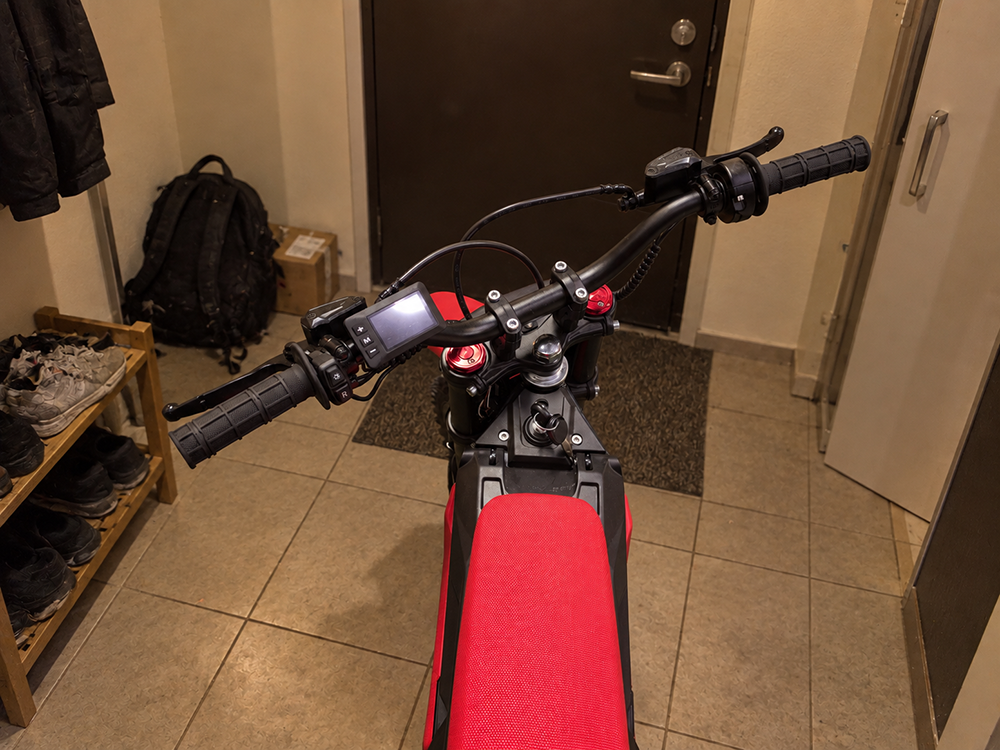
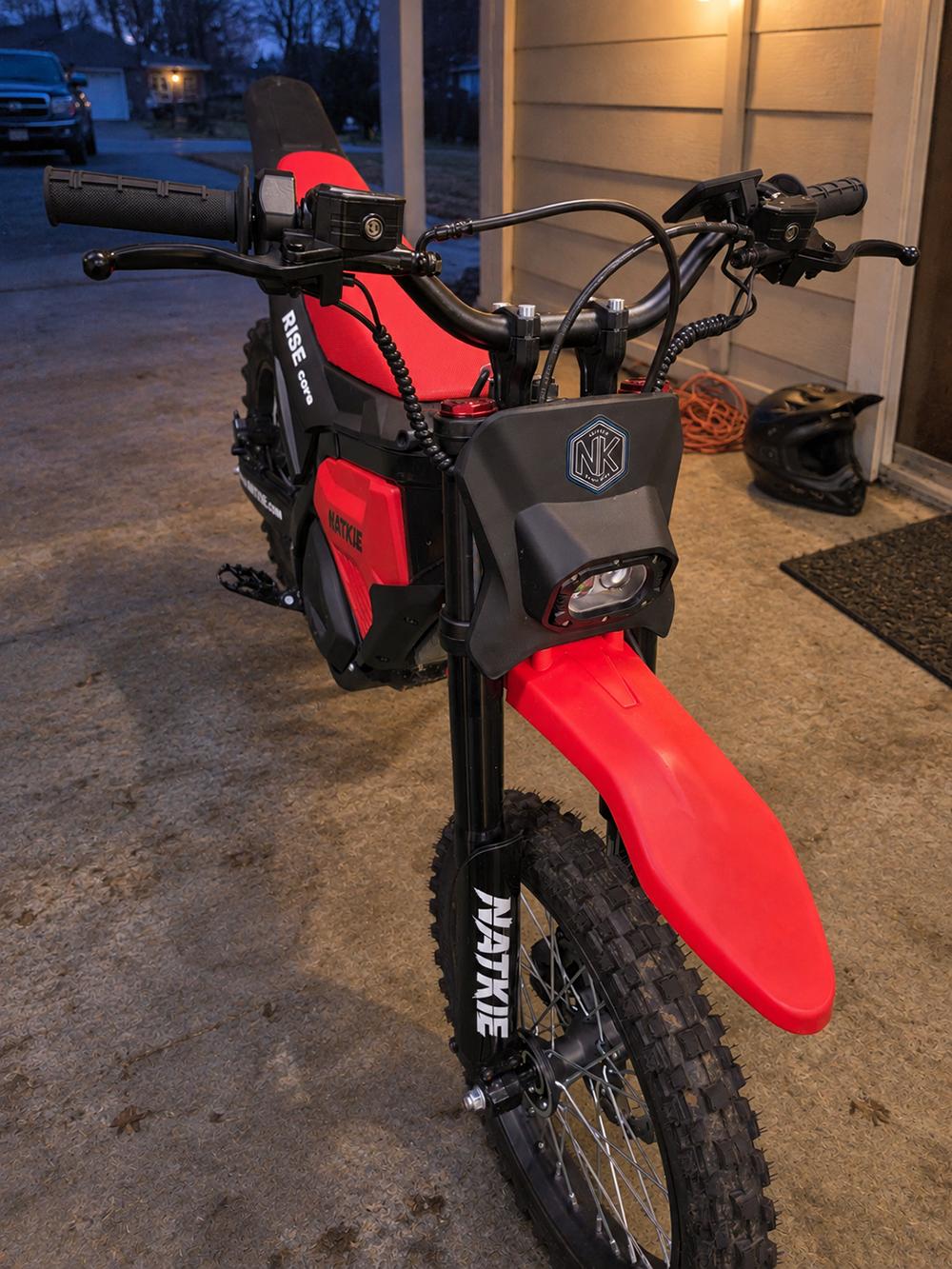
Our RISE Core combines its 60V 30Ah battery with a 5,700W peak mid-drive motor producing up to 250 N·m of listed torque.
It reaches up to 52 MPH with a listed range of 30–62 miles.
Compared with our RISE Mini, the RISE Core also moves to a larger 17-inch front and 14-inch rear wheel setup.
This highlights another important point.
The move from 48V to 60V is not simply an electrical upgrade. Within our lineup, it is also part of a larger platform designed for riders who want more trail capability, stability and performance.
For many riders, that balanced package may be more useful than simply choosing the highest-voltage bike available.
8. 72V Electric Dirt Bikes: Built for Higher-Performance Systems
A 72V electric dirt bike makes the most sense when the rest of the machine is designed to take advantage of the higher-voltage architecture.
Our Vortex N1 represents this category.
Its 72V 30Ah removable battery provides approximately 2,160Wh of nominal energy and supplies an 8,000W peak mid-drive motor producing up to 360 N·m of listed torque.
Our Vortex N1 reaches up to 50 MPH in Sports Mode with a riding range of 35–60 miles. It also uses full-size 19-inch front and rear wheels.
This makes it a very different platform from our smaller RISE Mini.
A rider choosing between them should not simply ask:
“Is 72V better than 48V?”
The more useful question is:
“Do I need the size, power and performance of the bike that the 72V system is designed to support?”
9. Higher Voltage Does Not Automatically Mean Faster Charging
Another common assumption is that higher-voltage batteries charge faster.
Again, not necessarily.
Charging time depends on several factors, including:
- total battery energy
- charger output
- charging current
- battery-management limits
- battery state of charge
- battery temperature
A larger 72V battery can contain substantially more energy that must be replaced after a ride.
For our lineup, charging times are approximately 3–5 hours for the 48V RISE Mini, 4–7 hours for the 60V RISE Core and 5–10 hours for the larger 72V Vortex N1 with their respective charging systems.
Voltage alone therefore tells you very little about charging time.
10. Can You Upgrade a 48V Bike to 60V or 72V?
You should not assume that batteries with different voltages are interchangeable.
The battery is only one component of the electric drivetrain.
The controller, motor, display, wiring, connectors, DC converters, battery-management system and charger all need to be designed for the system voltage they receive.
Connecting a higher-voltage battery to components that are not rated for it can damage electronics and create a serious safety risk.
For that reason, moving from 48V to 60V or 72V should not be treated like swapping to a larger fuel tank.
Use batteries and chargers approved for your specific bike and electrical system.
11. Which Voltage Should You Choose?
There is no universally best battery voltage.
Within our NATKIE lineup, the three voltage levels correspond to different bike sizes, drivetrain configurations and performance categories. That does not mean every 48V bike is designed for beginners or every 72V bike is intended only for experienced riders. Voltage is just one part of the complete bike.
Instead, consider the overall platform and the type of riding experience you want.
Choose our 48V RISE Mini when:
You want a compact and agile off-road platform with strong performance in a smaller, more manageable package.
Its 48V system works together with a 3,120W peak mid-drive motor to deliver capable trail performance while maintaining the compact dimensions that make the bike easier to handle on tighter terrain.
Choose our 60V RISE Core when:
You want a larger trail-oriented platform with significantly more motor power while maintaining a balance between agility, capability and usability.
The 60V RISE Core sits naturally between our compact RISE Mini and our full-size Vortex N1, combining a 5,700W peak motor with a larger wheel setup and stronger overall trail capability.
Choose our 72V Vortex N1 when:
You want a full-size, high-power off-road platform built around an 8,000W peak motor, 360 N·m of listed torque and 19-inch wheels.
Its 72V architecture supports the higher-performance drivetrain that defines the Vortex N1.
Even within our own lineup, voltage is only one part of the comparison.
Motor power, torque, battery watt-hours, wheel size, suspension, rider fit, brakes and overall bike design may matter just as much.
The Bottom Line: Voltage Creates Potential, Not Performance by Itself
A common mistake when comparing 48V vs 60V vs 72V electric dirt bikes is treating voltage like a performance rating.
It is not.
Higher voltage can help a drivetrain deliver high levels of power without requiring as much current for the same electrical output. It can also support the design of more powerful motors and higher-performance electric vehicles.
But battery voltage by itself does not tell you:
- how fast the bike will go
- how much torque it will produce
- how quickly it will accelerate
- how many miles it will travel
- how quickly it will charge
- whether it is the right bike for you
The comparison between our RISE Mini, RISE Core and Vortex N1 illustrates this clearly.
Our 48V RISE Mini is a compact 3,120W machine. Our 60V RISE Core steps up to 5,700W and a larger trail platform. Our 72V Vortex N1 moves into a full-size 8,000W performance category.
Each voltage level makes sense within the bike it was designed around.
So instead of asking whether 72V is better than 60V or 48V, compare the complete electric dirt bike.
That will tell you far more about how it will actually perform once the trail begins.


Share: