
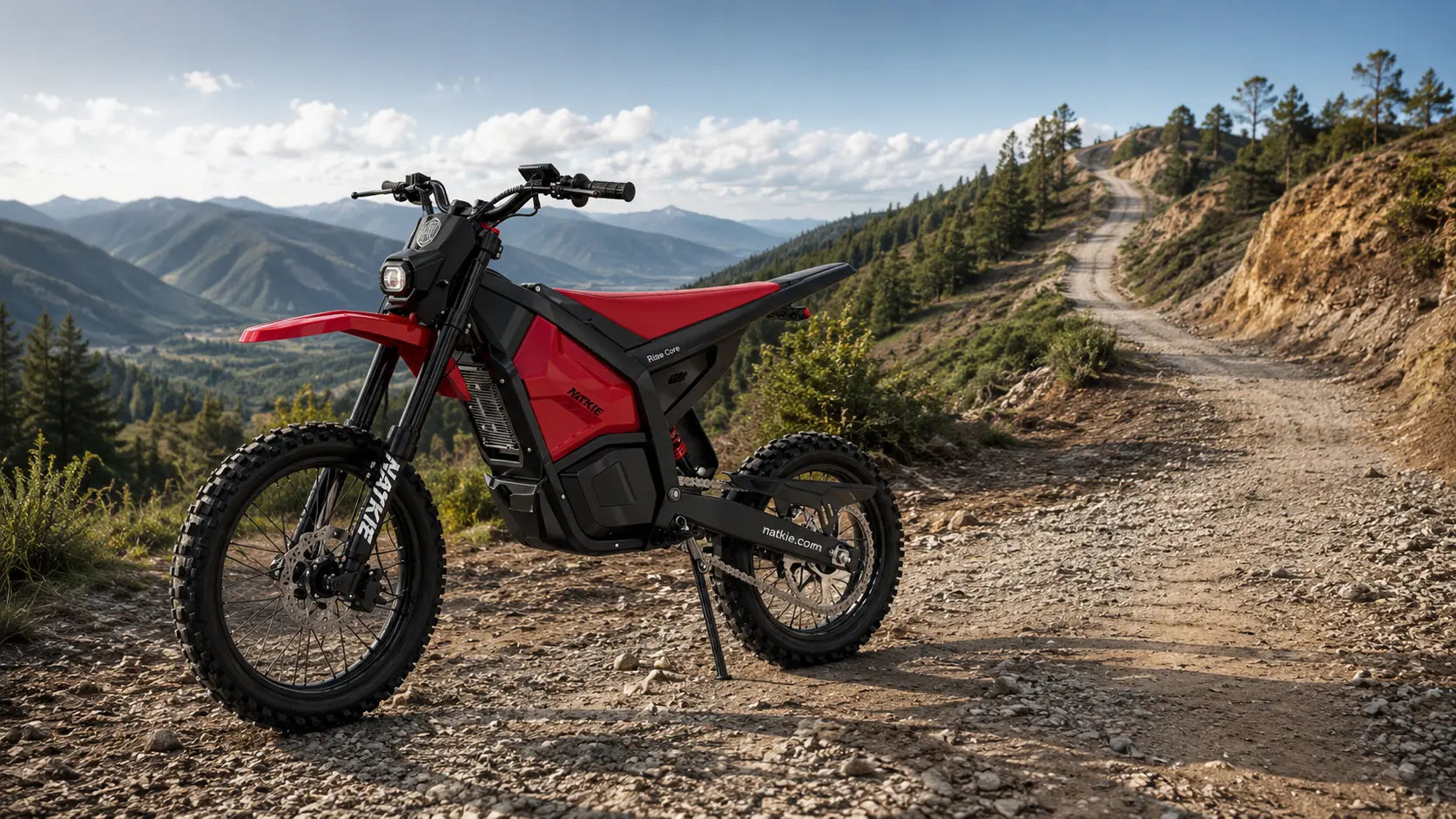
Electric Dirt Bike Range Explained: Why Your Real-World Miles Can Change
Electric dirt bike range is one of the first specifications riders look at when comparing bikes. A model that lists 50 or 60 miles of maximum range can immediately sound more attractive than one with a smaller number.
But a listed maximum is not the same thing as a guaranteed distance on every ride.
Two riders using the same electric dirt bike can finish the day with very different mileage. One may ride relatively smooth trails at moderate speeds, while another spends the entire ride accelerating hard, climbing steep hills, and crossing loose terrain.
Both riders are using the same battery. The amount of energy required to complete their rides, however, can be very different.
Understanding electric dirt bike range therefore means looking beyond one number and considering how speed, terrain, rider weight, temperature, tire pressure, riding mode, and riding style affect real-world energy consumption.
Electric Dirt Bike Range at a Glance
| Factor | What Usually Happens to Range |
|---|---|
| Higher speed | Usually reduces range |
| Hard acceleration | Uses more energy |
| Steep climbs | Can significantly increase energy use |
| Heavier rider/load | Requires more energy to move |
| Loose or soft terrain | Creates more resistance |
| Lower tire pressure | Can increase rolling resistance |
| Cold temperatures | Can temporarily reduce battery performance |
| Lower-power riding mode | Can help extend range |
| Smooth, steady riding | Generally improves efficiency |
These factors do not affect every bike or ride by exactly the same amount. They simply explain why the maximum figure listed by a manufacturer should be understood as a reference point rather than a promise for every trail.
1. What Does a Listed Electric Dirt Bike Range Actually Mean?
When you see a range figure on an electric dirt bike product page, it represents what the bike can achieve under particular conditions.
Those conditions may not match the way you ride.
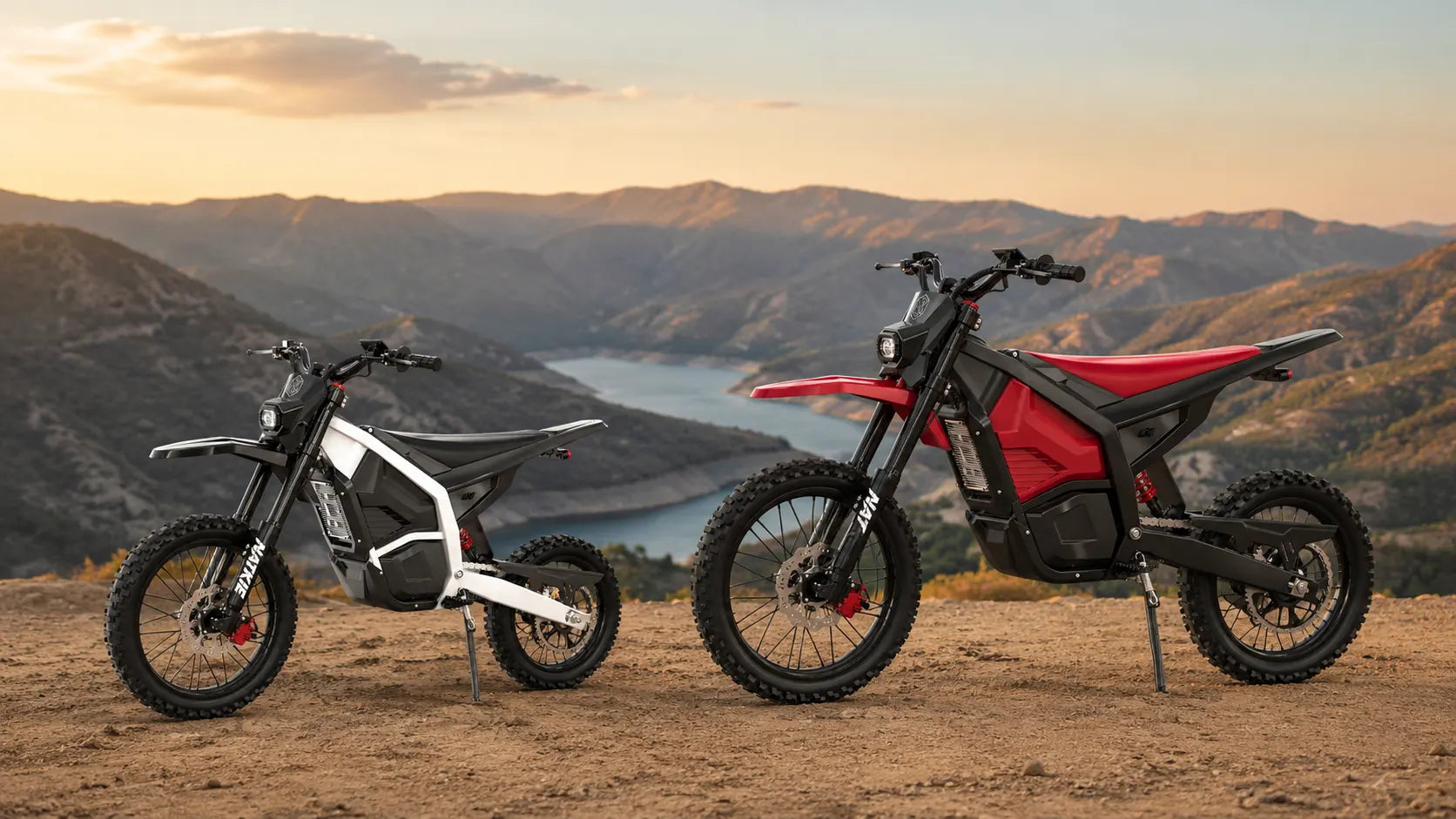
For our NATKIE RISE Mini, for example, we list a riding range of 20–55 miles from its 48V 27Ah lithium-ion battery. Our RISE Core uses a larger 60V 30Ah battery and has a listed range of 30–62 miles.
The fact that both models have a range rather than one exact mileage figure is important.
For the RISE Mini, for example, the exact result depends on factors including rider weight, terrain and the selected speed mode. The RISE Core follows the same principle: its published 30–62-mile range varies with riding conditions.
So if you ride fewer miles than the maximum figure, that does not automatically mean something is wrong with the battery.
2. Speed Has a Major Effect on Electric Dirt Bike Range
One of the easiest ways to consume more battery energy is simply to ride faster.
Higher speeds require the motor to provide more continuous power. Hard acceleration also asks the battery and motor to deliver more energy over a shorter period.
The U.S. Department of Energy notes the same general principle for electric vehicles: rapid acceleration can reduce driving range compared with gradual acceleration.
For an electric dirt bike, this becomes particularly relevant because off-road riding can involve repeated bursts of throttle.
Accelerating aggressively out of every corner, repeatedly riding near maximum speed, or constantly changing between heavy acceleration and braking will generally use more battery than maintaining a smoother pace.
That is why the fastest ride is rarely the ride with the longest electric dirt bike range.
3. Hills and Terrain Can Change Range Quickly
Off-road terrain creates another major variable.
A relatively flat hard-packed trail requires much less work from the motor than a long steep climb.
When the bike climbs, the motor must move the combined mass of the bike and rider against gravity. The steeper and longer the incline, the more energy this requires.
The U.S. Department of Energy also identifies significant inclines as a factor that can reduce electric-vehicle range.
Surface type matters too.
Loose sand, deep mud, soft soil, thick grass, and rough technical terrain can create more resistance than smooth hard-packed dirt. The motor has to work harder to maintain forward movement.
This explains why 25 miles of difficult off-road terrain can consume more battery than a substantially longer ride under easier conditions.
4. Rider Weight and Additional Load Matter
The electric dirt bike does not move by itself. It moves the bike, the rider, riding equipment, and anything else being carried.
More total mass generally means more energy is required to accelerate and climb.
This does not mean heavier riders should avoid electric dirt bikes. It simply means rider weight is one of the variables that affects real-world electric dirt bike range.
The effect becomes particularly noticeable when additional weight is combined with repeated acceleration or climbing.
A heavier rider cruising steadily on relatively flat terrain may still achieve efficient range, while a lighter rider aggressively climbing steep trails may use considerably more battery.
It is the complete riding situation that matters.
5. Battery Size Helps, but It Does Not Tell the Whole Story
Battery capacity is obviously important.
A useful way to compare nominal battery energy is watt-hours, calculated approximately as:
Voltage × Amp-hours = Watt-hours
For example:
RISE Mini:
48V × 27Ah = approximately 1,296Wh
RISE Core:
60V × 30Ah = approximately 1,800Wh
The RISE Core therefore carries substantially more nominal battery energy, which helps support its longer-range positioning alongside its larger, more powerful platform. Its motor, however, can also deliver considerably more output: 5700W peak compared with 3120W for the RISE Mini.
This illustrates an important point.
A bigger battery does not automatically translate into a proportional increase in real-world miles because the complete bike matters too.
Motor power, bike weight, rider weight, speed, terrain and riding style all influence how quickly that stored energy is used.
6. Riding Mode Can Help You Manage Range
Our RISE Mini and RISE Core both include three-speed riding modes as well as reverse.
Different riding modes give riders more control over how the available performance is used.
If maximum range is the priority, constantly using the most aggressive available performance is usually not the most efficient strategy.
A lower-power mode combined with smoother throttle input can help conserve battery energy, particularly on easier sections of trail where maximum performance is unnecessary.
This does not mean you should always ride slowly.
It means your riding mode can become another tool for managing electric dirt bike range during longer outings.
7. Tire Pressure and Rolling Resistance Matter Too
Tires are easy to overlook when discussing batteries, but they directly influence how efficiently a bike rolls.
If tire pressure is unnecessarily low, rolling resistance can increase and the motor may need to work harder.
Bosch's official eBike guidance also identifies tire pressure as a factor affecting range and notes that correct pressure can reduce rolling resistance.
For an off-road bike, however, this requires balance.
The pressure that produces maximum efficiency is not necessarily the pressure that provides the best traction and handling for every trail condition.
Always follow the recommended limits for your specific tires and bike rather than inflating tires purely to chase maximum mileage.
8. Cold Weather Can Reduce Battery Performance
Temperature also influences lithium-ion batteries.
In colder conditions, battery performance can temporarily decrease because internal electrical resistance increases. Bosch specifically notes that lower temperatures can reduce normal eBike range.
The same broad battery principle applies beyond e-bikes. The U.S. Department of Energy identifies extreme temperatures as a factor that can affect electric-vehicle efficiency and range.
This means a ride completed in warm, moderate weather may not produce the same electric dirt bike range as an otherwise identical ride in significantly colder conditions.
Battery temperature, storage conditions, and the conditions at the beginning of the ride can all matter.
9. Why Two Identical Riders Can Still Get Different Range
Even if two riders have similar body weight and use identical bikes, their mileage may still differ.
Consider two RISE Mini riders.
The first rider uses smoother throttle inputs, maintains moderate speeds, rides mainly hard-packed trails, and avoids unnecessary acceleration.
The second rider repeatedly accelerates hard, rides faster, climbs steeper sections, and spends more time on loose terrain.
The second rider is asking considerably more from the motor and battery.
Neither style is necessarily wrong. They simply have different energy requirements.
That is why asking “How many miles will this bike get?” rarely has one exact answer.
A better question is:
How much range can I expect for the way I actually ride?
10. How to Get More Electric Dirt Bike Range
If extending your ride is the priority, several simple habits can help.
Use smoother throttle inputs rather than accelerating aggressively every time you move. Select an appropriate riding mode for the terrain instead of always using maximum available performance.
Keep tires maintained at an appropriate pressure and inspect the drivetrain so unnecessary mechanical resistance does not develop.
Plan particularly demanding climbs and technical sections with battery capacity in mind.
And most importantly, learn your own bike.
After several rides, you will begin to understand what percentage of battery you typically use on your normal trails. That real-world experience is often more useful than trying to predict every ride from the maximum specification alone.
Should You Always Aim for the Maximum Listed Range?
Not necessarily.
The point of an electric dirt bike is not to turn every ride into an efficiency test.
Sometimes riders want maximum trail time. On another day, they may want stronger acceleration, more technical terrain, or more demanding climbs.
Those choices naturally change energy consumption.
The listed electric dirt bike range is therefore best used for planning and comparison rather than as a mileage target you must achieve every time.
It is also sensible to leave a reasonable battery buffer rather than planning a route that depends on achieving the absolute maximum published figure.
Final Thoughts
Electric dirt bike range is not one fixed number.
Battery capacity creates the available energy reserve, but how quickly that energy is used depends on speed, acceleration, rider weight, terrain, temperature, tire pressure, riding mode, and riding style.
Our RISE Mini illustrates this clearly with a listed 20–55-mile range, while the larger RISE Core is listed at 30–62 miles. Those ranges are intentionally broad because real-world off-road conditions vary considerably.
The most useful approach is therefore to treat manufacturer range figures as reference points, understand the factors that influence energy consumption, and learn how your own riding style affects your bike.
Once you understand those variables, electric dirt bike range becomes much easier to plan—and a lot less confusing.
Share: