
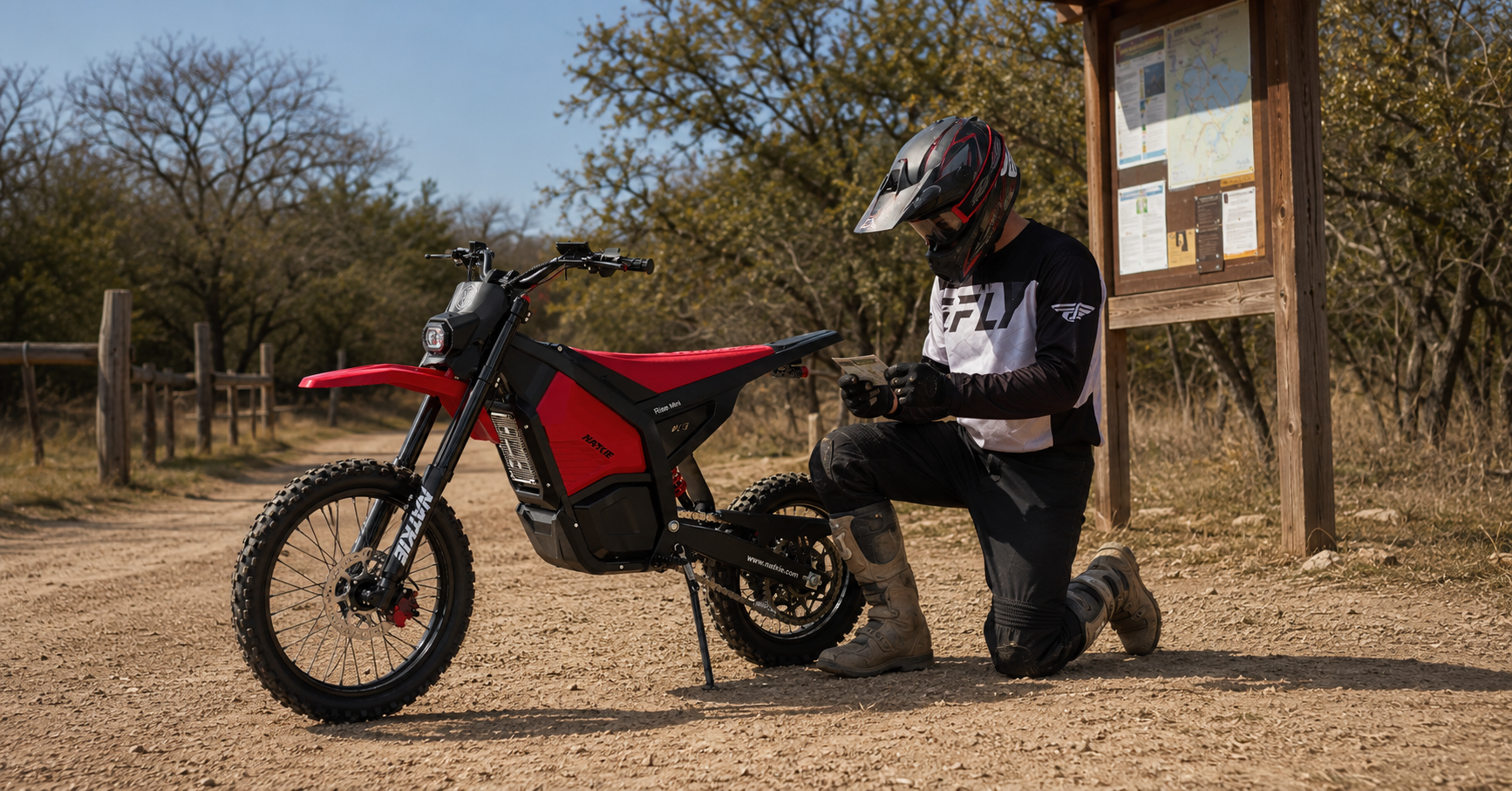
When Does an Electric Dirt Bike Need a Texas OHV Decal?
Understanding Texas OHV decal electric dirt bike requirements can be confusing because the rule does not depend only on the motorcycle. It also depends on where you plan to ride. A legal OHV venue on Texas public land can have different requirements from ordinary private property, while a privately operated park may still require a decal if it received qualifying Texas Parks and Wildlife Department grant funding.
At NATKIE, we recommend checking both the state program and the individual venue before every trip. A decal is not a universal riding pass, and it does not automatically confirm that a high-performance electric motorcycle is accepted at a particular property.
This guide is intended as general information for Dallas and Fort Worth riders, not legal advice. Prices, venue policies, trail access, and vehicle classifications can change, so recheck the official requirements immediately before riding.
What Is a Texas OHV Decal?
The Texas OHV decal is part of the Texas Off-Highway Vehicle Program. Revenue from decal sales supports the creation and improvement of legal OHV recreation areas in Texas. The decal applies at specified legal riding venues, but it is separate from park admission, a membership, a camping reservation, or any other venue fee.
Texas Parks and Wildlife currently lists the decal at $16. The program year runs from September 1 through August 31 of the following year. The fee is not prorated, so a decal purchased later in the program year still expires at the end of that same August 31 period. At a covered venue, the current decal must be properly mounted on the vehicle before riding.
The decal should therefore be treated as one compliance requirement, not as proof that every other condition for riding has been met. It does not reserve entry, cover a park’s own charges, or establish permission to use land where OHV access is not otherwise legal.
Where Is a Texas OHV Decal Required?
Texas Parks and Wildlife says a current decal is required for OHVs used at legal OHV venues located on public lands in Texas. This includes approved municipal, county, state, and federal lands where OHV recreation is legal.
The same requirement can apply at a private OHV venue that is open to the public and has received TPWD OHV grant money. This is why the question is not simply whether a property is public or private. Riders also need to know whether the venue was purchased, developed, or improved using qualifying recreational trail or state OHV funding.
For DFW riders, the safest approach is to check the venue’s own rules and the current Texas Parks and Wildlife OHV information before leaving home. Do not rely only on an older blog post, an online comment, or what another rider was allowed to do during a previous visit. Even when the state decal rule is clear, a venue may have additional conditions that determine whether you and your bike can enter.
What About Private Riding Property?
Ordinary private land generally does not require a Texas OHV decal when the rider has the landowner’s permission. The important exception is a private OHV venue that received qualifying National Recreational Trails Program or Texas OHV Program grant funding.
Texas Parks and Wildlife names Barnwell Mountain Recreation Area as an example of a privately operated venue where the decal requirement applies because qualifying grant funding was used.
Red River Motorcycle Trails shows how a different private-property policy can work. Its official FAQ currently states that the park does not require an OHV permit. The same page says helmets are required and night riding is not allowed. Because RRMT is a private property, it can also set its own entry, membership, camping, waiver, vehicle, and safety rules.
That current RRMT policy should not be treated as a permanent rule for every visit or as a rule for every private park in Texas. Contact the property before traveling, explain that you plan to bring a high-performance electric dirt bike, and confirm the current decal, entry, safety, and vehicle requirements.
Does an Electric Dirt Bike Count as an OHV in Texas?
A high-performance electric dirt bike should not automatically be treated as a low-speed street e-bike simply because both use electric power. The classification can depend on the motorcycle’s specifications, design, intended use, registration status, and the rules applied by the managing agency or venue.
Texas Parks and Wildlife states that motorcycles and other types of OHVs used at covered public-land or grant-funded venues must display a current decal. However, riders should not assume that every electric dirt bike has one fixed classification for every Texas purpose.
NATKIE models are designed as off-road electric dirt bikes. We position them for private land with permission, closed-course tracks, and approved OHV venues where this type of vehicle is allowed. Before visiting a park, describe the exact bike to the property manager and ask whether it is accepted. Where classification remains unclear, check with Texas Parks and Wildlife and the relevant local authority.
A Decal Does Not Guarantee Venue Access
Possessing a Texas OHV decal does not create legal access to public land where OHV riding is not otherwise permitted. It also does not replace a venue’s own admission process or confirm that a particular electric motorcycle meets that property’s rules.
A park may still require an entry payment, membership, signed waiver, helmet, eye protection, age supervision, vehicle inspection, or other safety equipment. A property may also restrict certain motorcycles, close trails after rain, limit riding hours, or require additional compliance for specific vehicle types.
Traditional equipment rules may have been written with combustion motorcycles in mind, but electric riders should still ask about all vehicle-specific requirements. That includes any inspection procedure, tire or lighting rules, trail restrictions, protective gear standards, and confirmation that high-performance electric motorcycles are accepted.
The decal is one part of preparing for a legal off-road ride. It is not a substitute for checking the complete venue policy.
How DFW Riders Can Obtain a Texas OHV Decal
Texas Parks and Wildlife currently offers three general purchase options: online, by phone, and through authorized dealers. Some OHV venues may also sell the decal.
Because dealers and purchase procedures can change, use the official Texas Parks and Wildlife decal purchase page rather than relying on a copied dealer list. The state page provides the current price, program dates, ordering options, and authorized purchasing locations.
DFW riders should obtain the decal early enough to avoid delaying a planned trip. Also remember that buying the decal does not reserve park entry, pay a day-use fee, or confirm that your motorcycle is accepted.
What to Confirm Before Leaving Dallas–Fort Worth
Before loading your bike, confirm all of the following directly with the venue:
- Does the property currently permit high-performance electric motorcycles?
- Is a Texas OHV decal required at this location?
- Is there a separate admission fee, membership, reservation, or waiver?
- Are there rider-age or supervision restrictions?
- What helmet and protective-equipment rules apply?
- Are the trails open after recent rain, maintenance, or special events?
- Is charging available, and is electric motorcycle charging permitted?
Do not assume that an RV electrical hookup means bike charging is allowed. Ask the venue whether charging is permitted and whether its electrical service is suitable for your charger. Plan enough battery capacity to return safely to the staging area even if charging is unavailable.
NATKIE Off-Road Use Reminder
NATKIE electric dirt bikes are intended for private land with permission, closed-course tracks, and approved off-road venues. They are not marketed or intended for public roads, sidewalks, bicycle lanes, pedestrian paths, or everyday commuting.
A Texas OHV decal does not change that intended use. It is a venue-related off-road requirement in certain situations, not public-road registration and not a guarantee that a NATKIE bike is legal or accepted everywhere in Texas.
Before every ride, verify electric motorcycle acceptance, trail status, fees, permits, safety requirements, and any local restrictions directly with the property or managing agency.
Explore NATKIE off-road electric bikes Texas riders can consider for approved trails, private properties, and closed-course riding.
Share: