
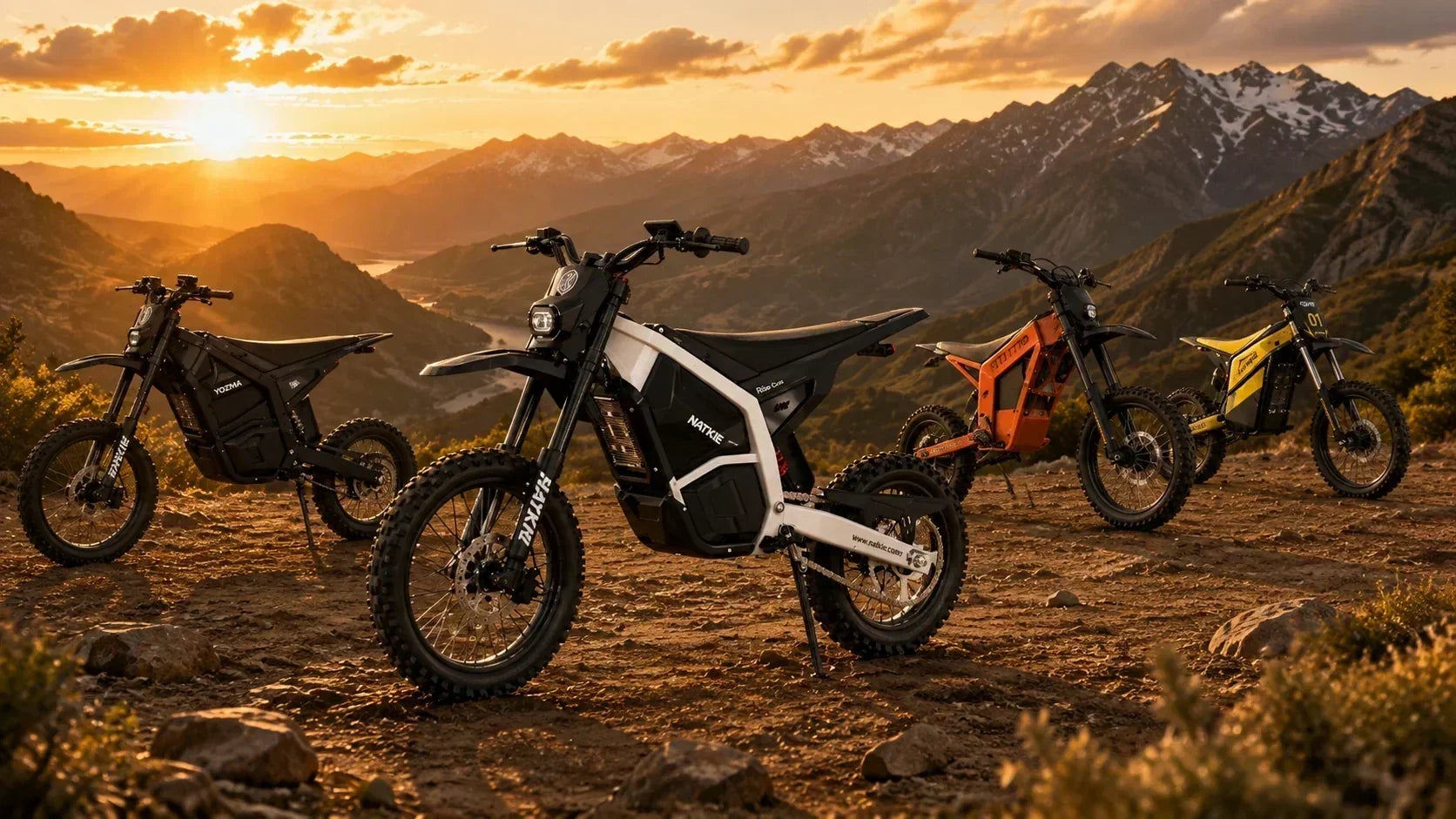
NATKIE vs Yozma vs Tuttio vs Heybike: How Do They Compare?
The electric dirt bike market has changed quickly. Riders who once had only a handful of recognizable options can now choose from compact off-road models with mid-drive motors, large batteries, hydraulic suspension, multiple riding modes, and performance that would have looked unusually ambitious just a few years ago.
NATKIE, Yozma, Tuttio, and Heybike all compete in this growing category, and their bikes can look surprisingly similar at first glance. That makes choosing between them less straightforward than simply picking the model with the highest wattage.
A useful electric dirt bike comparison should look at motor performance, torque, battery capacity, range, rider fit, suspension, and how those specifications translate into the type of riding you actually want to do.
For this comparison, we will focus mainly on four similarly positioned models: our NATKIE RISE Mini, the Yozma IN 10, Tuttio Soleil01, and Heybike V1.
Electric Dirt Bike Comparison at a Glance
| Model | Peak Motor | Torque | Top Speed | Battery | Approx. Nominal Energy | Claimed Max Range | Wheels |
|---|---|---|---|---|---|---|---|
| NATKIE RISE Mini | 3120W | 210 N·m | 42 mph | 48V 27Ah | 1,296Wh | 55 miles | 14" / 12" |
| Yozma IN 10 | 2600W | 146 N·m | 40 mph | 48V 23.4Ah | 1,123Wh | 53 miles | Compact mini platform |
| Tuttio Soleil01 | 3000W | 200 N·m | 40 mph | 48V 21Ah | 1,008Wh | 45 miles | 14" / 12" |
| Heybike V1 | 4160W | 190 N·m | 45 mph | 52V 26Ah | 1,352Wh | 50 miles | 14" / 12" |
These are manufacturer-listed figures, so real-world speed and range will vary with rider weight, terrain, temperature, tire pressure, riding mode, and throttle use.
The battery-energy figures above are calculated by multiplying nominal voltage by amp-hours. They provide another useful comparison point when voltage differs between bikes, but they should not be treated as a guarantee of real-world range.
1. NATKIE RISE Mini: Balanced Torque, Battery Capacity and Compact Fit
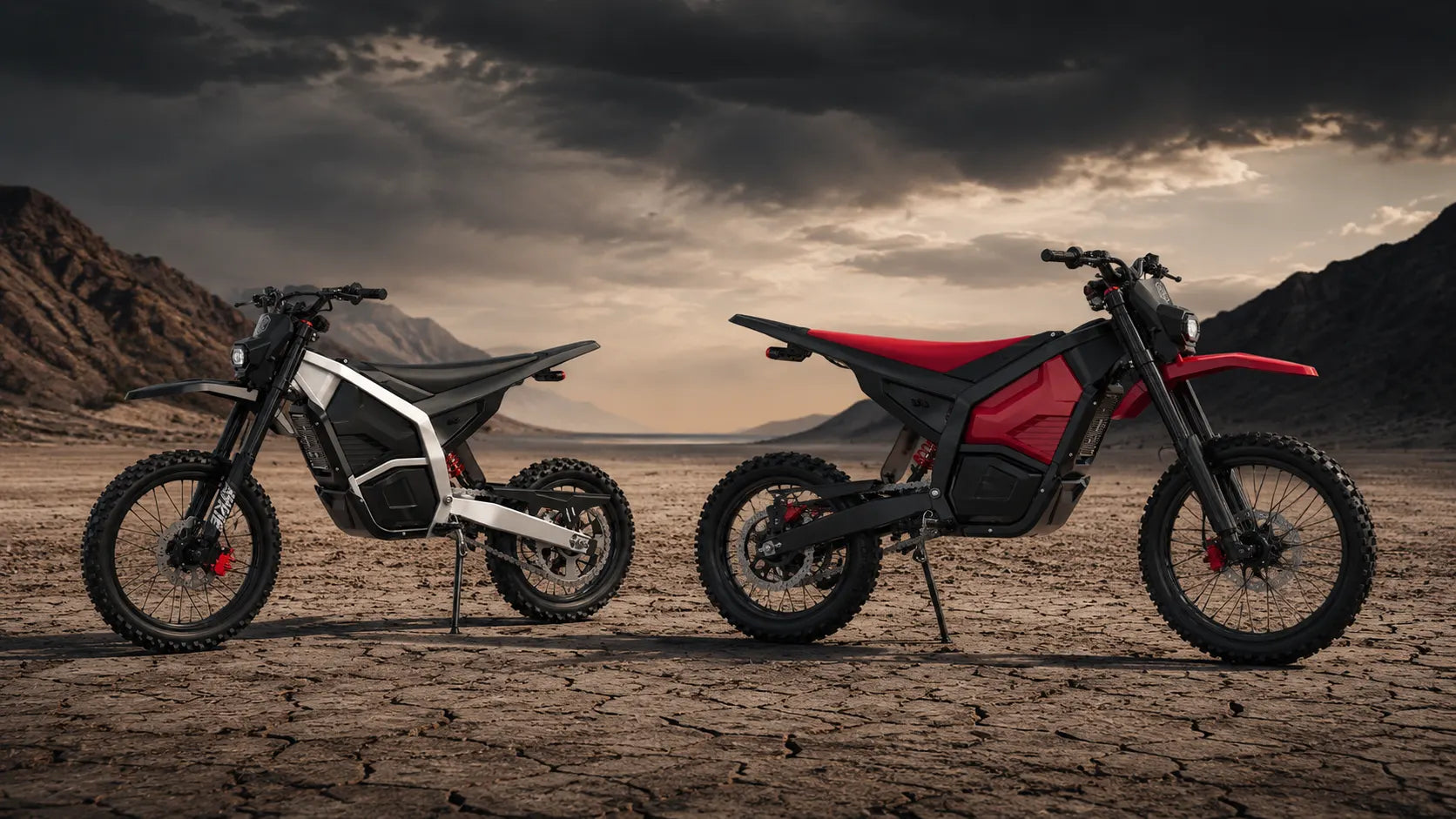
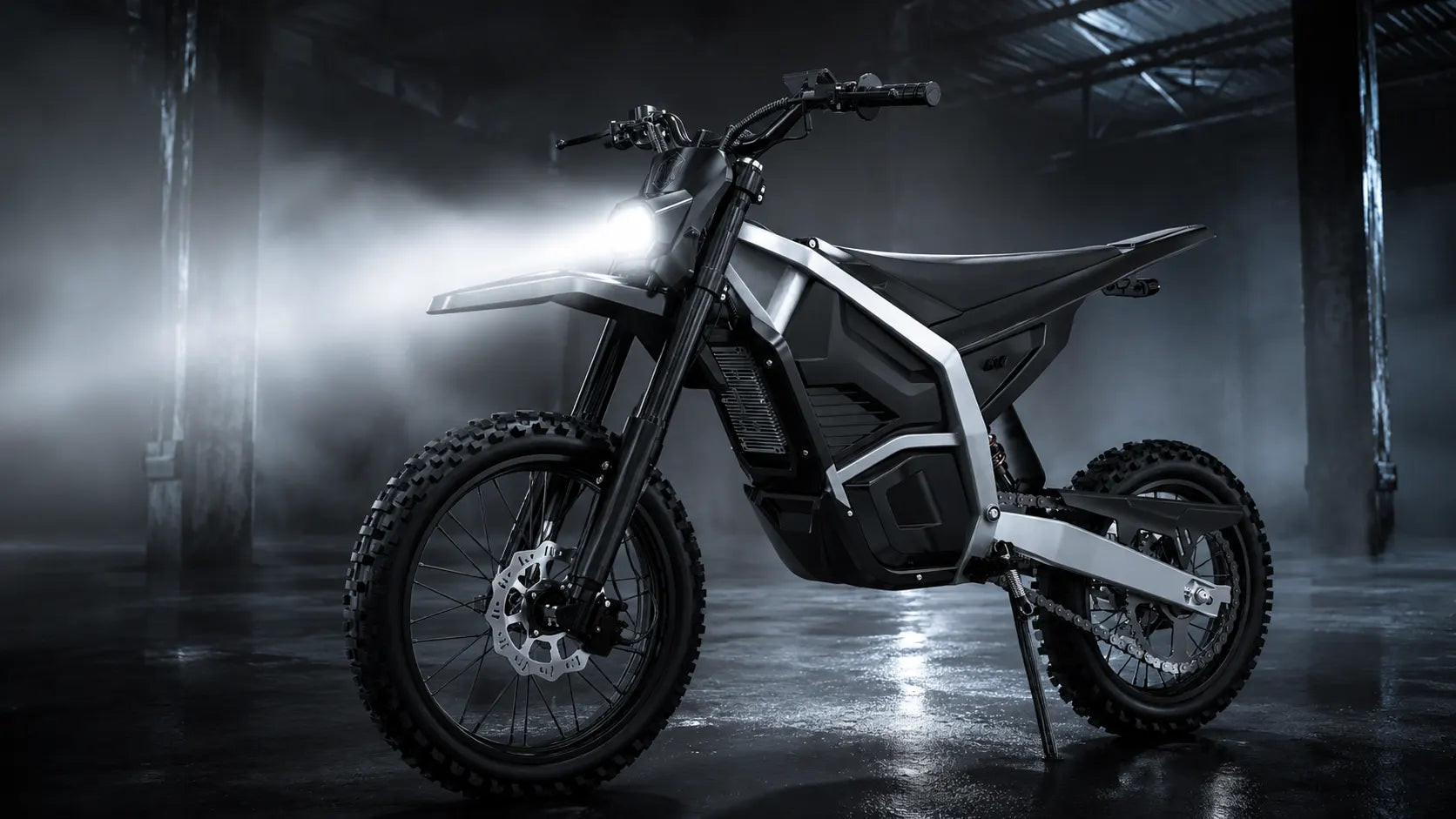
Our NATKIE RISE Mini sits at the compact end of our electric dirt bike lineup. It uses a 3120W peak mid-drive motor producing up to 210 N·m of torque, with a listed top speed of 42 mph.
The RISE Mini uses a 48V 27Ah battery, and we list a riding range of 20–55 miles with a charging time of approximately 3–5 hours. It also uses a compact 14-inch front and 12-inch rear wheel setup.
What stands out here is not necessarily one dramatic specification. Instead, our RISE Mini sits in the middle of the group for maximum speed while combining strong listed torque with substantial battery capacity.
That can make it an interesting option for riders who care about low-speed pulling power, trail riding, usable range, and controllable performance rather than simply chasing the highest possible top speed.
The RISE Mini also includes three riding modes, reverse assist, hydraulic suspension, hydraulic brakes, and a dedicated mid-drive layout.
2. Yozma IN 10: A Closely Matched Compact Alternative
The Yozma IN 10 competes directly with our RISE Mini.
Yozma lists a 2600W motor, a maximum speed of 40 mph, a 48V 23.4Ah battery, and up to 53 miles of claimed range. Its published specifications also list approximately 146 N·m of torque.
For riders comparing NATKIE vs Yozma, the differences are therefore more incremental than dramatic.
The IN 10 has slightly lower listed peak motor output and maximum speed, while its claimed maximum range remains close to the RISE Mini.
Based on the published figures, our RISE Mini offers higher listed torque, higher peak motor output, and greater Ah capacity at the same 48V system voltage.
Yozma also offers the more powerful IN 10 Pro, which moves into a different category with a 5500W motor, 60V 27Ah battery, 50 mph top speed, and up to 60 miles of claimed range.
3. Tuttio Soleil01: A Straightforward 3000W Alternative
The Tuttio Soleil01 is another close competitor in this electric dirt bike comparison.
Its published specifications list a 3000W peak mid-drive motor, approximately 200 N·m of torque, a top speed of up to 40 mph, and a 48V 21Ah battery with up to 45 miles of claimed range. It also uses the familiar 14-inch front and 12-inch rear wheel combination.
That makes NATKIE vs Tuttio an especially interesting comparison because the basic architecture is similar.
The Soleil01 comes close to our RISE Mini in motor output and listed torque. At the same 48V system voltage, our RISE Mini uses a larger 27Ah battery compared with Tuttio's 21Ah configuration. The RISE Mini also has a slightly higher listed maximum speed at 42 mph.
Tuttio's 3000W mid-drive setup still provides substantial performance in the compact off-road category.
For many riders, however, the difference between 40 and 42 mph will matter far less than fit, throttle response, suspension feel, braking, and how manageable the bike feels at lower speeds.
4. Heybike V1: Higher Peak Power and Top Speed
The Heybike V1 changes the balance slightly.
Heybike lists a 4160W mid-drive motor, approximately 190 N·m of torque, a 45 mph top speed, and a 52V 26Ah battery with up to 50 miles of claimed range. The V1 also uses 14-inch front and 12-inch rear wheels.
This gives the Heybike V1 the highest listed peak motor output and top speed among the four compact bikes compared here.
But the numbers also illustrate why wattage alone does not tell the full story.
The Heybike's 4160W figure is considerably higher than the RISE Mini's 3120W, while our RISE Mini lists 210 N·m of torque compared with Heybike's 190 N·m.
Battery comparisons also need a little more context because the Heybike uses a higher-voltage system. Comparing Ah alone can be misleading when voltage differs, which is why watt-hours are more useful when looking at total nominal battery energy.
For riders who prioritize higher peak motor output and top speed, the Heybike deserves attention. Riders who place more emphasis on listed torque, compact dimensions, and a different balance of off-road performance may reach another conclusion.
Battery Size Matters, but Ah Does Not Tell the Whole Story
Range is one of the easiest specifications to misunderstand in any electric dirt bike comparison.
The RISE Mini has a larger listed Ah capacity than the Yozma IN 10 and Tuttio Soleil01. Because all three use 48V systems, comparing their Ah figures provides a relatively straightforward indication of nominal battery capacity.
The RISE Mini uses a 48V 27Ah battery, the Yozma IN 10 uses 48V 23.4Ah, and the Tuttio Soleil01 uses 48V 21Ah.
The Heybike is different because it uses a higher-voltage 52V 26Ah battery. In this case, watt-hours provide a more useful comparison of total nominal battery energy.
Using the simple formula voltage × amp-hours, the approximate nominal battery energy is:
- NATKIE RISE Mini: 48V × 27Ah = 1,296Wh
- Yozma IN 10: 48V × 23.4Ah = 1,123Wh
- Tuttio Soleil01: 48V × 21Ah = 1,008Wh
- Heybike V1: 52V × 26Ah = 1,352Wh
This makes the comparison more accurate. Although our RISE Mini has a slightly higher Ah figure than the Heybike, the Heybike's higher system voltage gives it slightly more nominal battery energy in watt-hours.
Even watt-hours do not tell you exactly how far a bike will travel, however.
Aggressive throttle use, steep terrain, rider weight, soft surfaces, colder temperatures, tire pressure, riding mode, and higher speeds can all reduce real-world range significantly.
This is why manufacturer range figures are best treated as comparison points rather than guarantees.
Which Bike Is Better for Shorter or Beginner Riders?
All four bikes occupy a relatively compact part of the electric dirt bike market, but their fit ranges and overall dimensions differ.
A shorter rider should not assume that our RISE Mini will automatically feel smallest simply because it carries the “Mini” name.
Fit should always be evaluated using several factors together, including rider height, inseam, seat height, bike weight, wheel size, frame geometry, and previous riding experience.
The same principle applies to beginners.
A bike capable of 40–45 mph does not need to be ridden anywhere near its maximum speed while someone is learning.
Riding modes can be particularly useful because they allow new riders to become familiar with throttle response, braking, balance, and trail handling before exploring more of the bike's available performance.
For beginner riders, predictable and controllable power delivery can often matter more than the biggest motor number.
Torque vs. Peak Power: Which Specification Matters More?
Peak motor wattage is one of the easiest figures to advertise, but it should not be treated as the only measure of performance.
The Heybike V1, for example, has the highest listed peak motor output in this comparison. Our RISE Mini, on the other hand, has the highest listed torque figure among these four bikes.
Torque can become particularly relevant during lower-speed acceleration, climbing, and riding over rough or loose terrain.
Even then, a higher torque figure does not automatically make one bike better.
Motor position, controller tuning, throttle response, traction, wheel size, bike weight, suspension, and rider input all influence how that performance actually feels.
A useful electric dirt bike comparison therefore looks at how the complete machine works together rather than choosing a bike based on one specification.
Suspension and Braking Matter Too
Electric dirt bikes spend much of their time on surfaces where grip and stability constantly change.
Rocks, gravel, roots, holes, loose soil, and steep sections all require the suspension to keep the bike controlled while the brakes need to provide predictable stopping power.
This means suspension and braking deserve just as much attention as motor output.
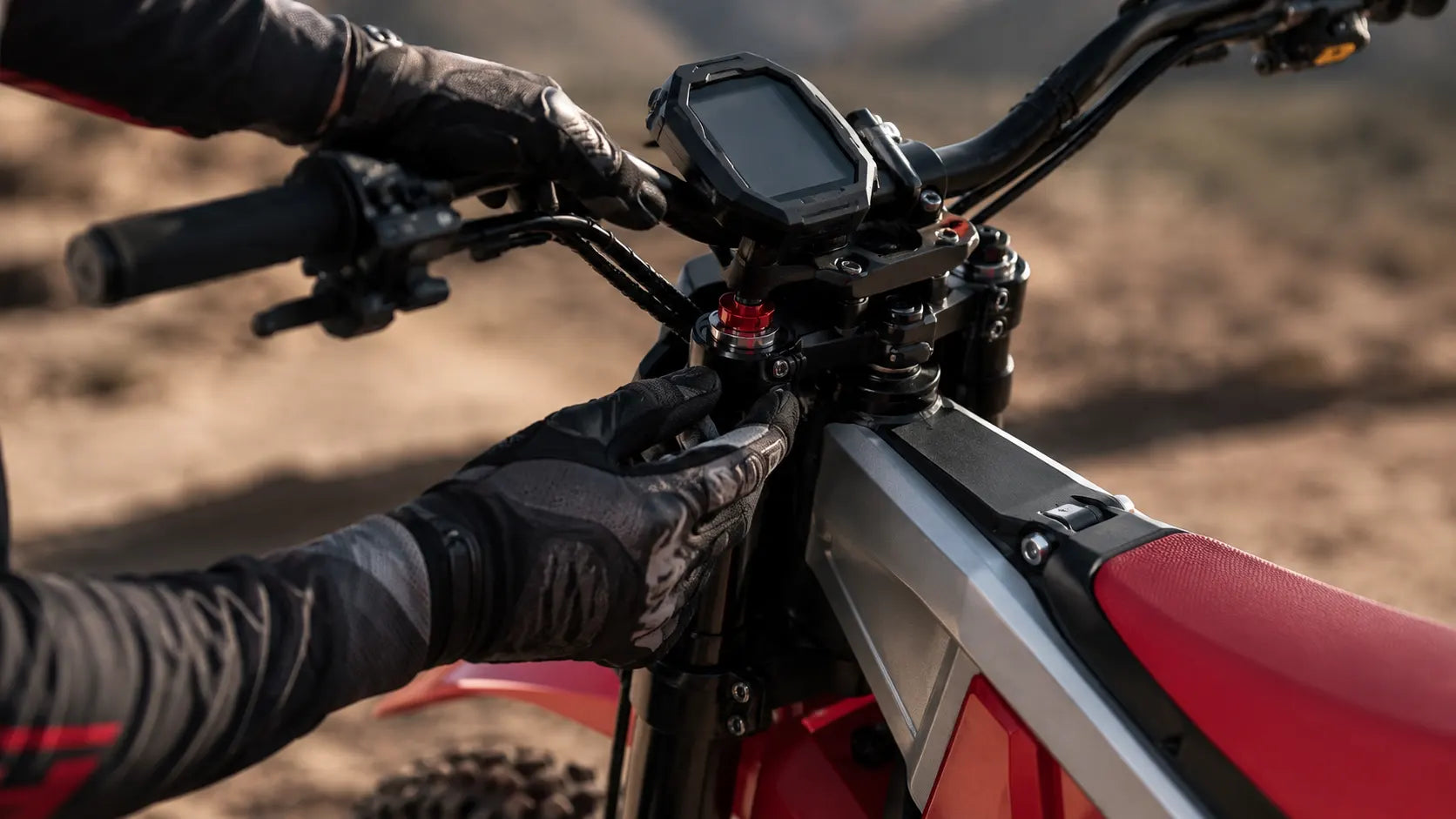
Our RISE Mini combines hydraulic front suspension, a rear shock absorber, and hydraulic braking with its compact off-road platform.
Yozma, Tuttio, and Heybike also equip their competing models with off-road suspension and braking systems designed for this type of riding.
Specifications still cannot fully describe how a suspension setup will feel in practice.
Rider weight, spring rates, damping, suspension travel, tire pressure, riding speed, and terrain can all affect the experience.
For buyers planning to spend more time on technical trails, suspension behavior may ultimately matter more than gaining another few miles per hour of top speed.
What If You Want More Than a Compact Dirt Bike?
For riders who want to move beyond the compact 14"/12" class, both NATKIE and Yozma currently offer larger step-up models.
Our NATKIE RISE Core moves into the larger 17-inch front and 14-inch rear wheel category. It combines a 5700W peak mid-drive motor with 250 N·m of torque, a listed 52 mph top speed, a 60V 30Ah battery, and up to 62 miles of claimed range.
This makes the RISE Core considerably more performance-focused than our RISE Mini while maintaining the same overall mid-drive off-road philosophy.
Yozma follows a similar step-up approach with the IN 10 Pro, which lists a 5500W motor, 50 mph maximum speed, a 60V 27Ah battery, and up to 60 miles of claimed range.
These models are relevant for riders who have already decided that the smaller compact category does not provide the size or performance they are looking for.
The broader performance e-moto market extends much further beyond the compact class compared here.
For perspective, the VORO Motors 2026 electric dirt bike ranking specifically focuses on larger performance e-motos and excludes smaller pit bikes, with several models using 72V–98V systems and peak outputs in the 15–22kW range.
Those machines therefore belong to a very different performance and price category and should not be treated as direct competitors to our RISE Mini.
The reference simply helps show how broad the electric dirt bike and e-moto market has become.
NATKIE vs Yozma vs Tuttio vs Heybike: How Do They Compare?
There is no universal answer because each bike emphasizes different specifications.
Our RISE Mini offers a balanced combination of 210 N·m of listed torque, a 48V 27Ah battery, a 42 mph top speed, a compact 14"/12" wheel setup, and up to 55 miles of claimed range.
The Yozma IN 10 provides a closely comparable compact platform with lower listed peak power and torque while maintaining a competitive claimed maximum range.
The Tuttio Soleil01 combines a 3000W mid-drive system, approximately 200 N·m of torque, and the same general 14"/12" wheel layout.
The Heybike V1 has the highest listed peak motor output and top speed among the four bikes compared here, while its 52V battery also gives it slightly higher calculated nominal battery energy than the RISE Mini.
The better choice therefore depends on what the rider actually values.
Someone prioritizing peak motor output and maximum speed may reach a different conclusion from someone focused on torque, battery capacity, rider fit, controllability, or the type of terrain they expect to ride.
Which Electric Dirt Bike Offers the Best Balance?
For riders who do not want to choose based purely on the biggest motor number, overall balance may be a more useful way to evaluate these bikes.
Our RISE Mini does not dominate every specification in this electric dirt bike comparison, and that is important to acknowledge.
The Heybike V1 has greater listed peak motor power and slightly more nominal battery energy. Other models may also appeal to riders because of their particular fit, dimensions, or other priorities.
Where we believe the RISE Mini is particularly competitive is in the way its specifications come together.
It combines a 3120W peak mid-drive motor with up to 210 N·m of torque, a 48V 27Ah battery, up to 55 miles of claimed range, a listed 42 mph top speed, multiple riding modes, and a compact 14"/12" off-road platform.
For riders looking for trail-focused torque, substantial battery capacity, compact dimensions, and enough performance to remain enjoyable as their skills improve, that balance can matter more than winning one individual specification.
Final Thoughts
A useful electric dirt bike comparison should go beyond one headline number.
Our NATKIE lineup, along with models from Yozma, Tuttio, and Heybike, shows how differently manufacturers can balance power, torque, battery capacity, speed, rider fit, and off-road performance within a relatively similar class of bike.
For our RISE Mini, the strongest argument is not that it dominates every specification. It does not.
Instead, we designed it around a balanced combination of strong listed torque, a substantial 48V 27Ah battery, compact 14"/12" wheels, multiple riding modes, hydraulic suspension and braking, and enough available performance to remain interesting as rider confidence grows.
If you want more performance and a larger platform, our RISE Core moves into the next category. If maximum peak wattage and top speed are priorities within the compact models compared here, the Heybike V1 deserves consideration. Yozma and Tuttio may also be better matches for riders whose priorities differ.
Ultimately, the right electric dirt bike is the one whose size, power delivery, battery capacity, range, suspension, and overall design best match how and where you actually intend to ride.
Share: