
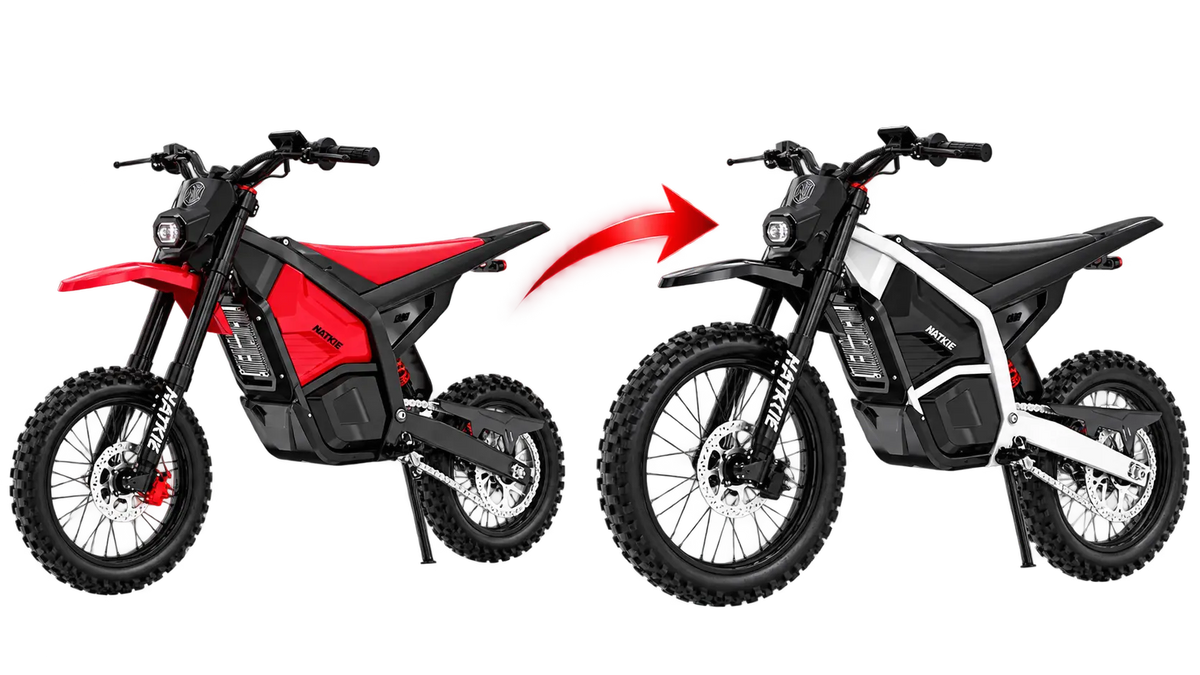
Moving from RISE Mini to RISE Core is about more than wanting more power or a higher top speed.There is a point in almost every rider’s progression when a familiar bike starts to feel different.
The trails that once demanded your full attention become more predictable. Tight turns feel natural. You stop thinking about every throttle input and brake application. Hills that used to look intimidating become the sections you actively look forward to.
And eventually, a new question appears:
Am I ready for more bike?
For riders on our RISE Mini, that can mean looking toward the RISE Core.
But moving from the RISE Mini to the RISE Core should not simply be about chasing a higher motor number or a faster top speed. The two bikes have different dimensions, power levels and riding characteristics, so the better question is whether your skills and riding needs have started to outgrow what you currently want from the Mini.
Here is how to tell.
RISE Mini to RISE Core: What Actually Changes?
Before talking about rider progression, it helps to understand what changes when you move between the two bikes.
| Specification | RISE Mini | RISE Core |
|---|---|---|
| Peak Motor Power | 3,120W | 5,700W |
| Listed Torque | 210 N·m | 250 N·m |
| Top Speed | 42 MPH | 52 MPH |
| Battery | 48V 27Ah | 60V 30Ah |
| Listed Range | 20–55 miles | 30–62 miles |
| Wheel Size | 14" front / 12" rear | 17" front / 14" rear |
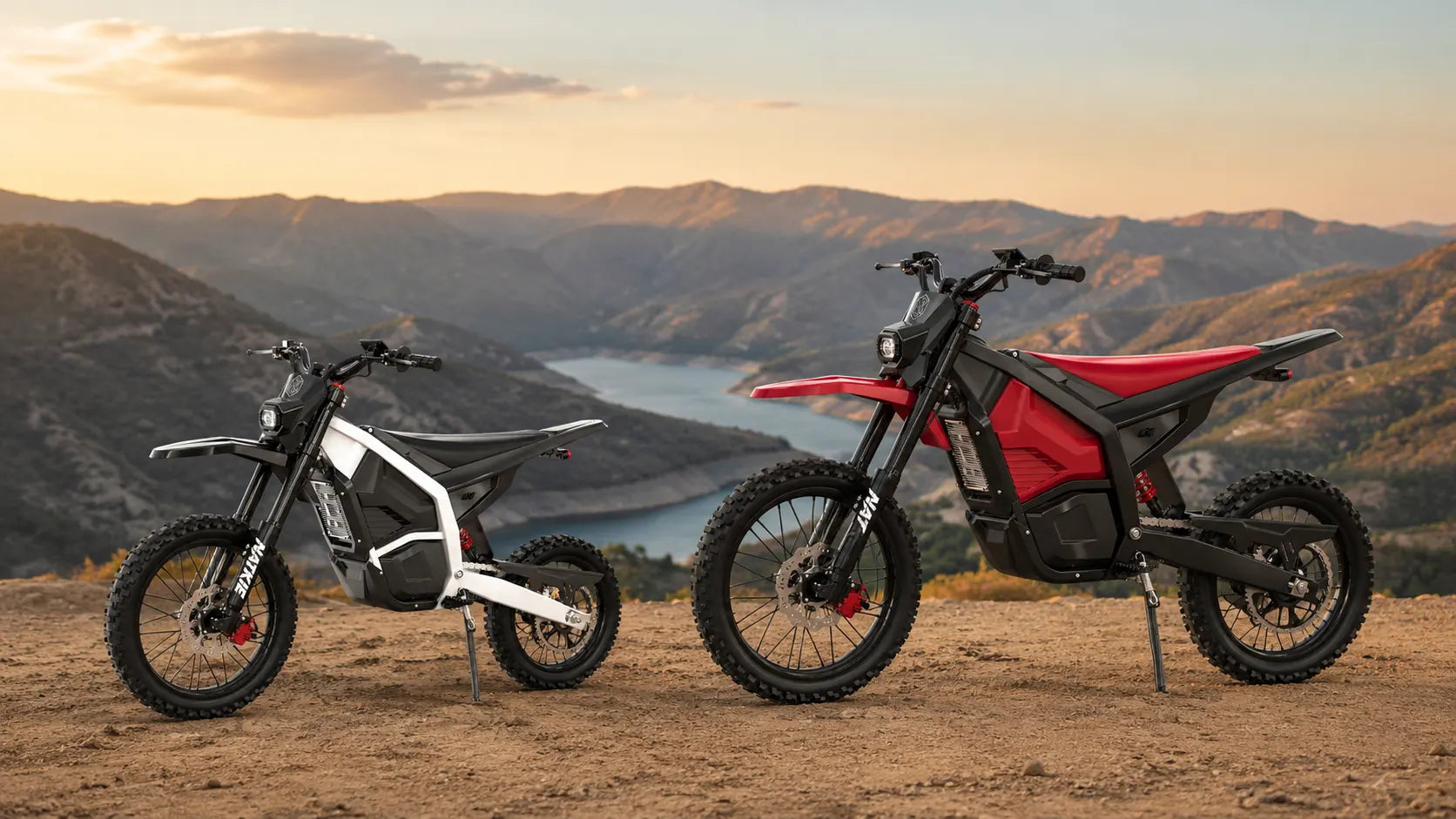
Our RISE Mini combines a 3,120W peak mid-drive motor, 210 N·m of listed torque and a compact 14-inch front / 12-inch rear wheel platform. Our RISE Core moves to a 5,700W peak mid-drive motor, 250 N·m of listed torque and larger 17-inch front / 14-inch rear wheels. Current published top speeds are up to 42 MPH for the Mini and 52 MPH for the Core.
Those numbers show a meaningful performance step.
But they still do not tell you whether you are ready for it.
Moving Up Is About Control Before Power
It is tempting to think that becoming ready for a faster electric dirt bike simply means no longer being afraid of the throttle.
That is only part of it.
A better sign is that you can control your current bike without constantly using all of your attention to do so.
Think about a normal ride on your RISE Mini.
Are your starts smooth rather than abrupt? Can you control speed through a tight section without repeatedly grabbing the brakes? Can you ride slowly without feeling unstable? Are you comfortable standing on the pegs when terrain gets rough? Can you choose a line before reaching an obstacle rather than reacting at the last second?
Those skills matter much more than whether you have already reached 42 MPH.
The Motorcycle Safety Foundation takes a similar progression-based approach in its DirtBike School. Its training begins with controls, smooth starting and stopping, posture, braking and turning before progressing toward obstacles, hills and more advanced trail riding.
For riders who want structured off-road training, the Motorcycle Safety Foundation DirtBike School is also a useful external resource.
Sign 1: You Are Comfortable at Low Speed
This might sound strange.
Why would low-speed riding tell you whether you are ready for a more powerful bike?
Because riding quickly in a straight line is relatively easy. Controlling a bike precisely when there is very little momentum is much harder.
Slow-speed riding exposes weaknesses in balance, throttle precision, braking and body positioning.
If you can comfortably ride your RISE Mini through tight sections, make controlled turns, stop accurately and maintain balance without putting a foot down every few seconds, that is a meaningful sign of progression.
It means you are controlling the bike rather than simply reacting to it.
Our own beginner riding guide emphasizes slow-speed practice because it helps develop balance, throttle precision, braking coordination and steering control—the same fundamentals that become even more important when moving to a more powerful machine.
Sign 2: Your Throttle Control Has Become Precise
The RISE Core gives you considerably more peak motor output than the RISE Mini.
That additional performance is useful only when your right hand can manage it.
Good throttle control does not mean being comfortable opening the throttle fully.
It means being able to use exactly as much power as the terrain requires.
On loose dirt, you should be able to accelerate without constantly breaking rear-wheel traction. On a technical climb, you should be able to add power progressively rather than suddenly. Coming out of a corner, you should be able to increase throttle smoothly as the bike straightens.
If your throttle inputs on the Mini still tend to be either on or off, spending more time developing precision may be more useful than moving to a more powerful platform.
When small throttle adjustments start feeling automatic, the additional performance of the Core becomes much easier to use properly.
Sign 3: You Are Beginning to Want More Performance on Specific Terrain
There is an important difference between:
“I want a faster bike.”
and:
“I keep reaching situations where more performance would actually help.”
The second one is a much better reason to move up.
Maybe your riding has shifted toward longer climbs where you want stronger sustained performance.
Maybe you are riding wider and faster trails where the Mini's compact nature is no longer your main priority.
Maybe you regularly ride with more experienced riders and find yourself wanting additional acceleration once the trail opens up.
Or perhaps your terrain has simply become more demanding.
That is where the RISE Core's 5,700W peak motor and larger platform begin to make more sense.
The goal is not to buy more performance simply because it exists.
It is to move up when your riding gives you somewhere useful to put that performance.
Sign 4: You Want a Larger Wheel Platform
One of the most meaningful differences between the RISE Mini and RISE Core is not actually the motor.
It is the wheels.
The RISE Mini uses a compact 14-inch front and 12-inch rear configuration, while the RISE Core steps up to 17 inches at the front and 14 inches at the rear.
That changes the physical character of the bike.
Larger wheels can make a larger platform feel more natural when riding over rocks, ruts and uneven terrain, while the Mini's smaller setup contributes to its compact and agile character.
You may therefore be ready for the Core even if you are not specifically searching for more top speed.
Maybe you simply want a bike that feels more substantial beneath you.
This is particularly relevant as riders become more confident tackling rougher terrain.
If physical fit is one of the main reasons you are considering the change, our Electric Dirt Bike Size Guide compares rider height, bike dimensions and wheel sizes across the NATKIE lineup. The published fit ranges overlap considerably, which is why height alone should not decide between the Mini and Core.
Sign 5: The Mini Feels Compact Rather Than Reassuring
When you first become comfortable with a dirt bike, a compact platform can be an advantage.
It is easier to understand what the bike is doing beneath you. Tight maneuvering can feel approachable, and correcting a small balance mistake may require less effort.
As your riding develops, however, your perception of that same bike can change.
Instead of thinking:
“I like how manageable this feels.”
you may start thinking:
“I would like a little more bike underneath me.”
That can be a sign that the Core is worth considering.
This does not mean the RISE Mini has suddenly become inadequate. Its 3,120W peak motor and 210 N·m of listed torque still make it a capable off-road machine.
It simply means your preference may now be shifting toward the larger proportions and additional capability of the Core.
Sign 6: You Have Started Riding Faster—Without Feeling Rushed
Speed itself is not a qualification for moving up.
Control at speed is.
A rider who frequently reaches high speeds but feels tense, reacts late to obstacles or brakes unpredictably is not necessarily ready for more performance.
A stronger sign is that your pace has increased naturally.
You look farther ahead.
You plan braking points earlier.
Your body remains relaxed.
You can change direction without making sudden corrections.
You leave yourself enough space to react when the terrain changes.
When higher speeds begin to feel controlled rather than chaotic, the additional performance available from the RISE Core becomes more useful.
Remember that the Core can reach up to 52 MPH compared with up to 42 MPH on the Mini.
That extra performance also means you need to be comfortable managing the consequences of carrying more speed into a corner or obstacle.
Sign 7: You Can Brake Hard Without Panicking
More acceleration naturally means braking deserves more attention too.
Before moving up, you should be comfortable applying the brakes progressively and firmly when necessary.
You should understand how the bike behaves when weight shifts forward.
You should be able to reduce speed before a corner rather than entering too quickly and trying to solve the problem halfway through.
And ideally, emergency-style braking should not be something you are experiencing for the first time after moving to a faster bike.
This is another reason rider progression is more useful than simply measuring how long you have owned the Mini.
Someone who practices braking, turns and low-speed control intentionally may develop much faster than someone who has owned the bike for a year but mainly rides straightforward trails.
There is no fixed number of weeks or months that makes someone ready for the Core.
Sign 8: Your Current Riding Style Matches What the Core Offers
The Core does not need to be treated as the automatic destination for every RISE Mini owner.
Some riders may continue preferring the Mini precisely because of its compact dimensions.
That is a perfectly valid choice.
Moving up makes more sense when the characteristics of the Core solve something you actually want to change.
Compared with the Mini, the Core gives you more peak motor power, more listed torque, a higher top speed, a larger battery and larger wheels. It also moves from the compact category toward a mid-size off-road platform.
If those differences match where your riding is heading, the upgrade has a clear purpose.
If they do not, there is no reason to move up simply because the Core sits above the Mini in the lineup.
When You Might Want to Stay With the RISE Mini
Being capable of riding the Core does not automatically mean you will enjoy it more.
The RISE Mini remains a strong option for riders who value compact dimensions, agility and responsive performance in a smaller package.
You may prefer to stay with the Mini if most of your riding takes place on tighter trails where maneuverability matters more to you than additional speed.
You may also simply prefer the physical feel of the smaller platform.
That is why we would not describe the Mini as something riders necessarily “graduate from.”
For some riders, moving to the Core is the natural next step.
For others, the Mini is already the platform that best matches the way they want to ride.
What If You Want More Range?
Range can be another reason riders start looking at the Core.
Our RISE Mini uses a 48V 27Ah battery and has a listed range of 20–55 miles, while our RISE Core uses a larger 60V 30Ah battery and has a listed range of 30–62 miles.
But range deserves the same caution as power.
A larger battery does not mean every rider will automatically achieve the maximum listed distance.
Speed, terrain, rider weight, temperature, repeated acceleration and riding style can all change real-world energy consumption.
Our Electric Dirt Bike Range Explained guide goes deeper into why actual riding range can vary.
So if range is pushing you toward the Core, think about how you currently ride rather than comparing maximum numbers alone.
RISE Mini to RISE Core: A Simple Readiness Check
Before deciding, ask yourself six questions:
- Can I control the RISE Mini confidently at both low and moderate speeds?
- Are my throttle and braking inputs smooth and deliberate?
- Can I ride technical sections without feeling that I am constantly reacting at the last second?
- Am I regularly riding terrain where more motor performance or larger wheels would be useful?
- Do I want the physical feel of a larger mid-size platform?
- Am I moving to the Core because it better matches my riding—not simply because its numbers are bigger?
If most of those answers are yes, the Core probably makes sense as the next bike to consider.
If several of them are still uncertain, there is nothing wrong with spending more time on the Mini.
More time developing technique will make the eventual transition easier—and usually more enjoyable.
RISE Mini vs RISE Core: It Is a Step Up, Not a Starting Over
One of the best things about progressing from the RISE Mini to the RISE Core is that you are not learning everything again.
The fundamentals remain the same.
You still need smooth throttle control.
You still need good braking technique.
You still need balance, vision, body positioning and sensible line choice.
What changes is the amount of performance available and the physical platform carrying you through the terrain.
The RISE Core gives you more room to explore faster, rougher and more demanding riding as your confidence develops.
But the skills you built on the Mini are what allow you to use that additional capability properly.
The Bottom Line: Move Up When Your Riding Does
There is no magic mileage figure that tells you when to move from the RISE Mini to the RISE Core.
And there is no rule saying you need to move up at all.
The better indicator is what is happening during your rides.
If you are comfortable with low-speed control, precise with the throttle, confident with braking and increasingly riding terrain where a larger platform and additional performance would be useful, the RISE Core may be a natural next step.
Share: